This semester has been very interesting, it started out with earthquakes and ended up with a pandemic. But on the bright side I’ve learned a lot from it. Because of my computer science course I learned how to organize and create a blog. I learned a lot about the internet and different websites where i can save and organize the articules that i choose. I had a good experience with this class and I feel like I’ve learned. lot. Two things that interested me the most about this course was making the blog and also learning about the information that some sites have about us. One of the important things that I learned from this course was the information about facial recognition, that was my final project for this class. It was a very interesting topic and I learned new things about it. Another important thing that I learned was what kind of computer I should buy If I’m studying film. I have no complaints about this course, I think is great the way it is.
For my computer course we were divided in groups to present different technologies. We had to discuss how they used the technology, for what they used it and look for experts on the topic. My group’s topic is Facial Recognition, there is more information about it on one of my recent posts which I’ll leave the link to it below.
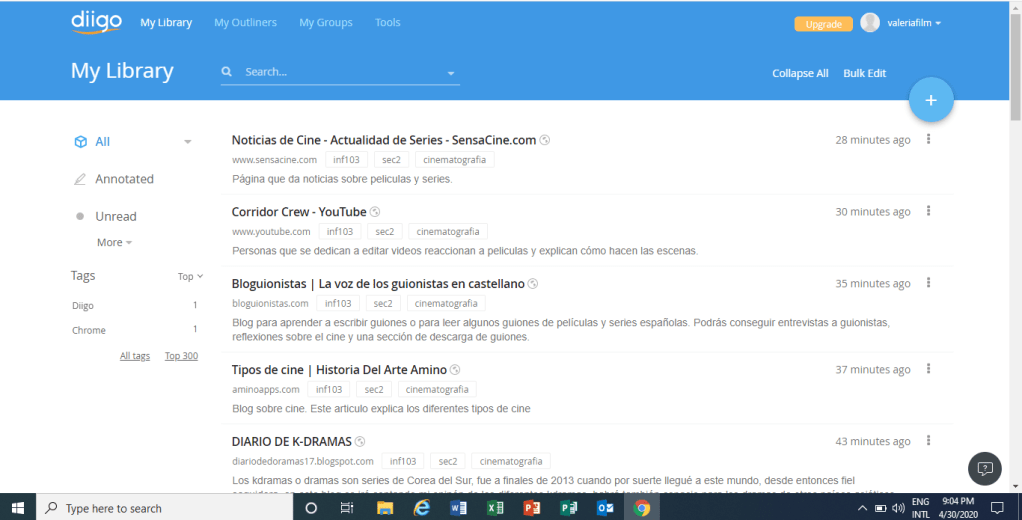
Diigo is a website that allows you to collect online bookmarks, annotate webpages, and share that information with others. Any annotated items can then be uploaded and organized in an outlining document. For my class I had to collect bookmarks about a final project that my group and I are working on. I collected bookmarks about my final project and also about cinematography. I collected different sites,videos and blogs about film, some showed reviews, scripts and others teached film techniques. Here I’ll leave the link to my bookmark library:
El reconocimiento facial es una tecnología que se utiliza todos los días y nos no percatamos. Esta tecnología es la forma de autenticación biométrica que utiliza medidas corporales para verificar tu identidad. Es un subconjunto de datos biométricos que identifica a las personas mediante la medición de la forma y estructura únicas de sus rostros.
Los inicios del reconocimiento facial
Esta tecnología ha existido desde los años 60 cuando Woodrow Wilson Bledsoe trabajó en un sistema para clasificar los rasgos del rostro humano a través de la tabla RAND. Este sistema utilizaba un lápiz óptico y unas coordenadas para situar los ojos, la nariz o la boca de las personas de forma precisa, era un procedimiento manual. Luego en los años 70 Goldstein, Harmon y Lesk detallaron estas características faciales e iniciaron la mejora hacia la precisión del reconocimiento facial. A finales de los años 80, se aplica el álgebra lineal, gracias a Sirovich y Kirby. En 1991, Turk y Pentland desarrollan la tecnología que era capaz de detectar un rostro humano dentro de una fotografía, esto abrió el paso al reconocimiento facial automático. El reconocimiento facial se fue utilizando en las aplicaciones de seguridad. En 2001 surge el Viola-Jones Object Detection Framework, que propone algoritmos para detectar objetos dentro de imágenes, y que enseguida fue utilizado para la detección de rostros de forma exitosa. En la década actual, aparecen los Convolutional Neural Networks, que hasta hoy son el mejor modo de detectar rostros, haciendo uso de sistemas muy potentes capaces de almacenar información en la nube. En el 2010 esta tecnología llega al público a través de Facebook. Esta tecnología se ha vuelto controversial ya que muchos ciudadanos y medios de comunicación cuestionan la privacidad de sistemas de este tipo. Por esto Facebook anuncio en septiembre de 2019 que elimina la utilización de reconocimiento facial permitiendo a sus usuarios decidir si desean utilizarla o no.
Cómo funciona el reconocimiento facial?
video por BBC News Mundo
Todos los sistemas de reconocimiento facial capturan una imagen bidimensional o tridimensional de la cara de una persona, y luego comparan la información clave de esa imagen con una base de datos de imágenes conocidas. En el caso de las fuerzas policiales, esa base de datos puede ser recopilada de fotografías de identificación policial. El reconocimiento facial 2D utiliza puntos de referencia como la nariz, la boca y los ojos para identificar un rostro. Mide tanto el ancho y la forma de los rasgos, como la distancia que hay entre ellos en la cara. Estas mediciones son convertidas luego en un código numérico mediante un software de reconocimiento facial, que se utiliza para encontrar coincidencias. Este código se conoce como “huella facial”. El software de reconocimiento facial en 3D no se basa en el tamaño promedio de una cabeza para identificar una huella facial. Con cámaras que detectan profundidad, la huella facial puede incluir los contornos y la curva de la cara, así como la profundidad de los ojos y las distancias a partir de puntos de referencia como la punta de tu nariz.
Aplicaciones que utilizan el reconocimiento facial
FACEFIRST: Esta aplicación es popular entre las fuerzas del orden público y el ejército. Brinda a los usuarios la posibilidad de tomar fotografías de personas en el campo e instantáneamente relacionarlas con una base de datos de personas conocidas. Esto puede ayudar a establecer rápidamente la identidad. Como resultado, los oficiales de la ley pueden mantener sus comunidades más seguras, al tiempo que reducen los arrestos falsos. Los oficiales también pueden inscribir a presuntos delincuentes en su lista de observación directamente desde el campo.
BLIPPAR: Es una aplicación afirma ofrecer la capacidad de reconocer plantas, animales, puntos de referencia e incluso su cena. También tiene un componente de reconocimiento facial que le permite reconocer a las personas.
VASCO: Esta aplicación fue creada para ayudar a proteger los dispositivos contra ataques de malware mediante la autenticación biométrica, como reconocimiento de huellas digitales y reconocimiento facial.
Expertos en el reconocimiento facial
Mark J. Fenske
Experto en Interacción emoción y cognición, neuroimagen, reconocimiento facial y de objetos y autorregulación.
Profesora asociada en ingeniería eléctrica e informática
Experta en biometría, computación gráfica, visión por computador, reconocimiento facial, gráficos hápticos, la interacción persona-ordenador, procesamiento de imágenes, aprendizaje automático, imágenes medicas y realidad virtual en salud.
Ha estado trabajando en EECS, Facultada de Ingeniería, Universidad de Ottawa, Canadá desde septiembre de 2003.
Guía, G., Pilar, S., Dionisio, P., & Rosario, M. (1970, January 1). Reconocimiento facial y estructuras de grupos humanos: una propuesta práctica de aprendizaje basado en problemas para Etología en los estudios de Grado en Biología. Retrieved from https://idus.us.es/xmlui/handle/11441/38740
-Referencia que contiene mas información sobre el reconocimiento facial.
-El objetivo de este trabajo es analizar la aceptación por parte de los ciudadanos de la tecnología de reconocimiento facial como medida de seguridad. Está basado en el índice de predisposición tecnológica (TRI) y el modelo de aceptación de las tecnologías (TAM). Luego de establecer un modelo de investigación, la metodología utiliza una encuesta a 220 chilenos para obtener los datos, que son analizados con la técnica de mínimos cuadrados parciales (partial least squares). Los resultados del análisis indican que la utilidad percibida del reconocimiento facial como medida de seguridad es explicada en un 50% por las variables normas sociales, percepción de responsabilidad, optimismo, grado de innovación, y percepción de inseguridad.
-En este trabajo se presenta una aplicación de detección facial por Eigenfaces que usa Microsoft Visual Studio con diversas herramientas de programación como C# y librerías de la plataforma Emgu CV asociadas a OpenCV. El desarrollo de la aplicación se codificó en dos partes: una de registro y la otra de reconocimiento. El proyecto se sometió a la parte experimental con un universo del tamaño de diez usuarios, en el que ocho usuarios son hombres y dos usuarios mujeres, haciendo diez pruebas por usuario obteniendo una matriz de confusión con resultados del 100% de reconocimiento incluso con usuarios no registrados.
According to google, privacy is the state or condition of being free from being observed or disturbed by other people. We all think we have privacy every time we are alone in our home, just chilling and doing whatever we want, but is that really true? Now a days we know that privacy doesn’t really exist. We basically have all our information in our computers and phones. The social apps like Facebook, Instagram, Twitter, and others, have a lot of information about us. More information that we might not even imagine they could have. There are a lot of movies about this topic, for example the movie “The Circle”. Is about a woman that is hired to work at the Circle, and it’s the world’s largest and most powerful tech and social media company. She is encouraged by the company’s founder to engage in a experiment that pushes the boundaries of privacy, ethics and ultimately her personal freedom. Her participation in the experiment, and every decision she makes, begin to affect the lives and future of her friends, family and that of humanity.
The Circle Trailer
Google and other sites have a lot of information about us, for example what we like, where we live, what we do. We can give them access to what they can know about us. If we accept for them to see our location, then they”ll know our every move. Other sites like Facebook, Instagram, YouTube,etc, also knows what we search and use to for advertisement.There is a site called http://disconnect.me , you can use it to see what companies watches what your searching. I did this and when I searched a product on google two of all the sites that i saw appear where Facebook and You Tube. Now a days we put all our information in our devices without thinking properly the consequences. So do we really have our privacy? I don’t think so. Not only because this big companies knows our personal information, but also because hackers exists.
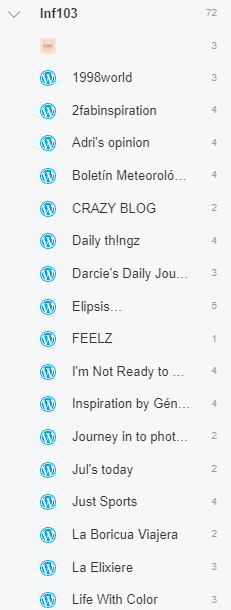
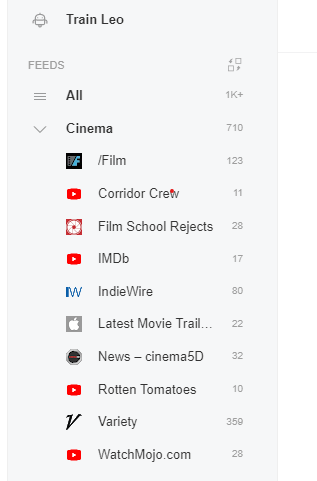
Hello nerds! This post is to inform all of you about Feedly. Feedly is an app and website that lets you add, organize and quickly access various web browsers. Once you add a site it updates you, showing you what you haven’t read yet. I have 3 profiles: technology, cinema and inf 103.
In my cinema profile I have news about upcoming movies and also sites that give ratings of movies and series. There’s also some sites that show how some movie scenes were made. My inf 103 profile is my class profile and in it I added the blogs of the people in my class. Finally, in my technology profile there are news about technology. News about new technology, technology tips, sites that inform you about hacking, how to know if you’ve been hacked and all sorts of things.
AnthonyPadilla: https://www.youtube.com/user/AnthonyPadilla – Este youtuber tiene contenido de comedia. También hace videos para informarle a las personas sobre diferentes temas que mayormente se consideran controversiales. Lo hace por medio de entrevistas.
Corridor Crew: https://www.youtube.com/user/samandniko – Es un grupo de personas en un estudio de producción que realizan videos reaccionando a películas o series. También crean sus videos con efectos especiales y explican cómo lo hacen.
Hi nerds, this post is to inform you all that I”ve updated my blog for my inf103 class. I’ve added my about page, my profile, and updated my homepage. Hope all of you enjoy it! Here is the link to my about page: https://filmingnerd.movie.blog/about/ I’ll be posting more soon!
Por: Thomas Olmo Velàzquez y Valeria Rodríguez Santos
Titular: Cómo editar nuestro blog
El profesor comenzó la clase enseñándonos cómo añadir una columna de la clase en twitter en Tweetdeck.twitter.com. A continuación se encuentran los pasos a seguir.
Seleccionar el signo de positivo (+) que se encuentra a la izquierda
Seleccione buscar
Buscar #inf103 #sec2
Añadir columna
Cerrar sección
Luego de eso el profesor nos mostró cómo añadir otra página a nuestro blog en WordPress en el cual hablaríamos de nuestra información personal con foto entre otras cosas. Aprendimos a editar la página web, añadirle menús y saber como posicionar la misma en el menú de nuestra página web.
Las páginas se editan igual que como se editan los post. Los pasos a seguir para añadir el About a la página son los siguientes:
Iniciar sección en WordPress
Seleccionar customize
Seleccionar menús
Seleccionar Primary y luego marcar primary en la parte de abajo.
The internet is a source a lot of us use for various things. We have gotten used to it more than we imagine. We use it before we go to sleep, when we eat, in the bathroom, with our friends, and more ways. The internet is a big thing and we only use a small part of it. We spent so many hours on social media, watching other people’s lives and sometimes we don’t realize it. It can be a good thing and a bad thing. Is good for when you need information for a homework, when you need a food recipe or for communication. The bad part is that we spent so much time on it that we stop being productive. We are depending on it by using it whenever we are bored or feel uncomfortable, also by putting our personal information on it. There are a lot of hackers that could have that information easily and use it to their advantage. They can use it to blackmail you or simply to steal your money. Another dark part of the internet is that we can get influenced by the things we see. Now a days a lot of kids act the way they do because of what they see on the media. The majority of things that are in the media right now are people ho call themselves influencers and all they do is show off their money and make drama. The audience tries to imitate this people and often create a toxic environment.
A lot of this content causes teenagers to feel insecure about how they look. They feel that if they want look pretty they should change everything about them, that being emotionally and physically. A lot of people think about having plastic surgery or saving money just to buy the car of the year. The only content that this influencers post out there, has to do with money or doing something crazy and stupid. Not all influencers are like that, some don’t even like to be called that way. There are some content creators that talk about social topics and raise awareness about serious and important things. Some topics that are considered controversial or taboo. In the internet there is a lot of hate. There’s going to be a lot of people that if they don’t agree with the content, they will write hate comments, not caring about hurting others. Now days people get offended easily, anything you put at the internet can be taken out of context.
Youtuber Anthony Padilla interview with autistic people
I think we all should take a break from the internet sometimes. It can affect us psychologically, it can make us feel stressed and unhappy sometimes. But it can also be used to express and share anything you want. You can share your art or other favorite hobbies and topics. We can learn from youtube videos about all kinds of things, for example https://www.youtube.com/watch?v=fcD94e93cCk food recipes. You can also learn more about taboo subjects and learn from them, like in Anthony’s channel https://www.youtube.com/watch?v=OYFbdpqnno4. The internet isn’t all bad, we can all learn from them and it can help us get things done easily.



 The Filming Nerd